
 Volume 88, Issue 4, October-December 2025
DOSSIER
Fichte and Sartre. Two thinkers of intersubjectivity
 Ives Radrizzani, Foreword
Marco D. Dozzi, Self-consciousness as (im-)mediacy, reflection, and lack
Both Fichte and Sartre are commonly thought to regard self-consciousness as immediate, in the sense of not requiring the performance of a self-directed mental act; thanks largely to the influence of Dieter Henrich, such a view is commonly designated as a “non-reflective” theory of self-consciousness. In this essay, I argue that this thesis is only correct if such an act refers to conscious attention to moreover, it inherently strives to become something that is not only impossible, but logically self-contradictory.
Hui Gao, Pre-reflective subjectivity
This article examines parallels between Fichte’s theory of consciousness and Sartre’s existential phenomenology. Despite their differences, both explore the foundations of consciousness, with Sartre’s pre-reflective cogito often seen as closer to Fichte than Descartes. Scholars debate whether Fichte can be viewed as a “proto-existentialist.” This study asks whether Sartre’s account of consciousness can address critiques of Fichte’s theory, particularly regarding the possibility of unmediated reflection, and whether this approach offers a way out of the circularity in consciousness.
Marco Ivaldo, The essence of freedom in Sartre, with reference to Fichte
This contribution takes into account, within certain limits, the understanding of freedom in Sartre’s thought, as developed in Being and Nothingness (1943), and then in the 1946 lecture on existentialism. This presentation will be compared, again within certain limits, with Fichte’s thinking on freedom, as expressed in Foundations of the Science of Knowledge. Sartre and Fichte are, each in their own way, philosophers of commitment and action. Taking into account their original concepts can bring a decisive enrichment to research on freedom.
Fabio Laiso, The concept of absolute consciousness
The purpose of this article is to show the existence of a fundamental orientation that links the theoretical-cognitive structure of Sartre’s thought to Fichte’s idealism, that is, their common transcendental approach. Although, as will be seen, the new way in which Sartre interprets the notion of “transcendental” will lead his conceptual system to results opposite to that of Fichte. The thesis is that, if we want to compare the thought of the two authors beyond generic analogies or differences, we will have to start from this original co-belonging.
Ives Radrizzani, Community and happy consciousness vs. solitude and unhappy consciousness
In the first part, this article offers an existentialist reading of Fichte, emphasizing the synthetic nature of the starting point of philosophy, the importance of reciprocal action and limits, and the centrality of intersubjectivity and concrete ethics, in situation, open to risk and condemned to freedom. The second part compares Fichte and Sartre. Despite a close systematic relationship, there is a fundamental divergence between them on the idea of community: Fichte develops a philosophy of happy consciousness, while Sartre’s thinking is fundamentally one of unhappy consciousness.
Angela Renzi, The concept of freedom: Autonomy, choice, duty, and commitment
This article examines whether autonomy and choice are the focal points of freedom in Fichte and Sartre. By investigating different aspects of their philosophies, it examines whether it is legitimate to emphasize the analogy of a practical conception in which the individual can self-determine on the basis of an ontologically primary choice of self, which takes the form of an ongoing task and commitment and which refers us back to the world of concrete life.
Dossier de lecture
Jürgen Habermas, Also a History of Philosophy
What is the relationship between secular reason and religious belief?
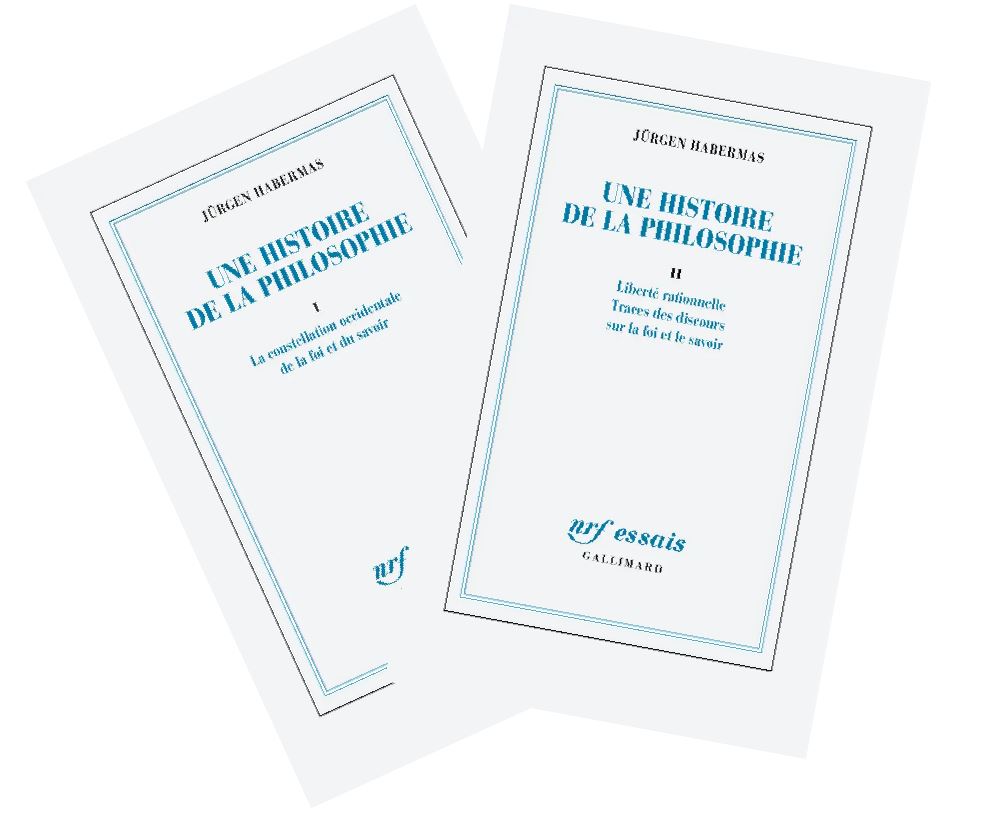
Gilles Marmasse, Foreword
Julia Christ, From evolutionary tendencies to historical traces of Reason. On Jürgen Habermas’s final work
This article undertakes an analysis of a pivotal moment in Habermas’s late thought. Confronted with the limitations of procedural rationality, Habermas embarks on a philosophical quest, seeking in the annals of philosophy the “traces of Reason” that might serve to reinvigorate the rational utilization of freedom. A dichotomy emerges between in fine (evolutionary tendency toward reflexivity) and in actu (observable breakdown). This development calls into question the relationship between philosophy and the social sciences: Can the latter compete with philosophy in maintaining Reason’s motivational power?
Jean-Marc Durand-Gasselin, The space of reasons and the dynamics of the sacral: Habermas as a reader of Sellars and Brandom
The project of Habermas’s Also a History of Philosophy can be understood as a critical rewriting, within the coordinates of the theory of communicative action and from the angle of the relations between faith and knowledge, of the historical and logical relations identified by Sellars between manifest image and scientific image of the world, logical space of reasons and space of causes. This rewriting can be seen as a corrective of materialist spirit, which consists in interposing, in the articulation defended by Sellars between Darwin and Kant, Marx and Durkheim.